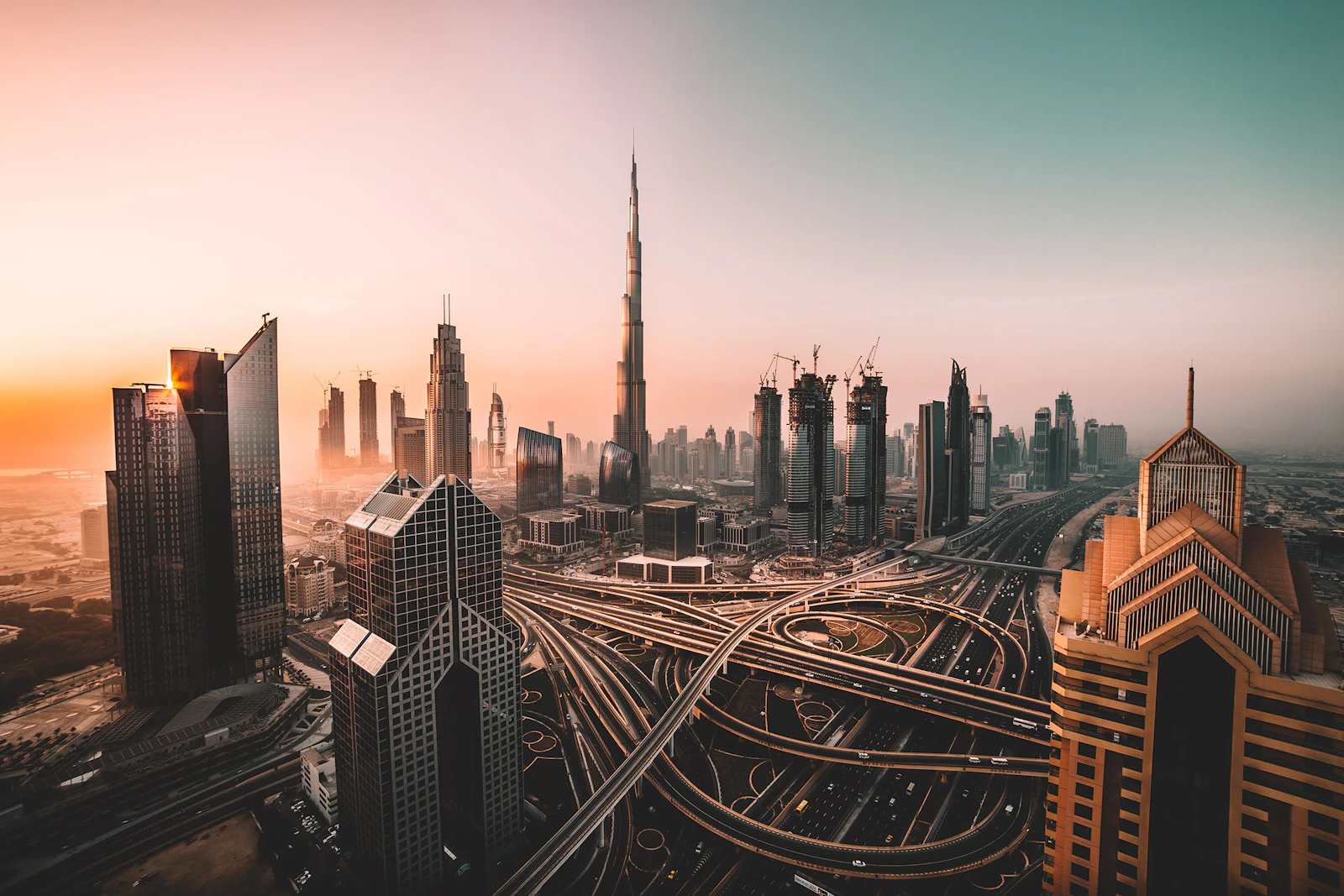
The question arrives at our desk weekly, usually framed as either/or: "Should I buy in Dubai or back home in Ghana?" Our answer, after walking dozens of clients through it, is almost always the same — the question isn't which market is better. It's which market is better for the job you need this money to do. The two markets are good at different things, and the strongest portfolios we manage hold both.
01Yield: the income test
Both markets are genuinely strong here — by global standards, exceptional. Dubai's yield districts (JVC, Business Bay, sections of the Marina) typically deliver 6–8% gross, paid in dollar-pegged dirhams, with deep tenant pools and professional management everywhere. Prime Accra (Cantonments, Airport Residential, Labone) often quotes 7–10% gross, frequently in actual US dollars from embassy and corporate tenants.
Accra's headline yield is higher; Dubai's is easier to actually collect at scale — management, tenant replacement and rent enforcement are all more frictionless. Call it a draw that tilts toward Ghana for hands-on owners and toward Dubai for absentee ones.
02Capital growth: the patience test
Dubai is a mature, cyclical market: it boomed hard into the mid-2020s, and entry timing matters. The long-term drivers — population growth, visa reform, global wealth migration — remain firmly intact, but nobody should underwrite a repeat of the last cycle's pace.
Ghana is the earlier-stage story. Established prime districts grow steadily; the sharper appreciation sits on the growth corridors — East Legon's extensions, the airport city sprawl, the Aburi ridge — where urbanisation is doing the heavy lifting. Higher potential, longer timelines, wider error bars.
03Currency & capital protection
This is Dubai's clearest win. The dirham has been pegged to the US dollar since 1997 — a Dubai asset is a dollar asset, full stop. Prime Accra partially mitigates cedi exposure by quoting prime rents and values in dollars, but the underlying economy still moves in cedis, and repatriating proceeds involves more friction.
Dubai protects capital. Ghana grows it. The right portfolio asks both to do what they do best.
04Liquidity & ease of transaction
Dubai transacts like a global financial product: title transfer at the Dubai Land Department can complete in days, the buyer pool is worldwide, and exit is rarely the problem (price is). Ghana remains a relationship market — sales take months, the buyer pool is thinner, and paperwork diligence is non-negotiable. If you may need the capital back within a couple of years, that alone decides the question.
05The intangibles
- Residency: Dubai offers the ten-year Golden Visa at the AED 2M threshold. Ghana offers something different — home. Land, legacy, family presence. They aren't substitutes.
- Lifestyle use: a Dubai apartment doubles as your Gulf base; an Accra home doubles as your December anchor. Most clients genuinely use both.
- Emotional return: never underrated at our desk. Building at home carries meaning a portfolio line never will.
06The verdict
| You should lean… | If your priority is… |
|---|---|
| Dubai first | Capital preservation, dollar income, easy exit, residency optionality, fully managed ownership |
| Ghana first | Maximum yield, long-horizon growth, home-soil presence, family legacy, lower entry points |
| Both (our usual answer) | A resilient portfolio — Dubai as the anchor, Ghana as the engine, weighted to your timeline |
The Pablo position
For a first $500K, we most often structure 60/40 — a Dubai income asset for stability and a prime-Accra holding for growth — then rebalance as conviction and capital build. Book a consultation and we'll model it against your actual numbers.